The small, well-equipped presentation room of Clemens 120 filled Monday night at 6 p.m. for a presentation and discussion put on by the University at Buffalo’s Environmental Networking club (EN) on the importance of Diversity and Divestment with their guest speaker JD Hartman, a former Wall Street banker
Hartman opened up with an anecdote about going from a semi-homeless political science grad to working in, arguably, the biggest investment collaboration in the world. He said It relied on one thing. Privilege.
“I just had access, you know what I mean?” Hartman recounted when telling about his efforts time and time again walking in to baking companies cold and asking to schedule an interview. He emphasized that as a white man in New York City In the early 1980’s privilege is “what gets you through the front door”.
Eventually getting his in, and moving up the chain Hartman became the assistant vice president at JP Morgan Chase, and then the senior managing director at Lebenthal & Co. Inc.
Hartman notes the irony he felt at Lebethol & Co., being on a board full of white men at a finical company founded by a woman. He then used the term ‘groupthink’, defined by Merriam-Webster as “A Pattern of Thought Characterized by self-deception, forced manufacture of consent, and conformity to group values and ethics.”, to describe the issues you run into when working on collaborative projects with an ethnically, or socioeconomically homogeneous group.
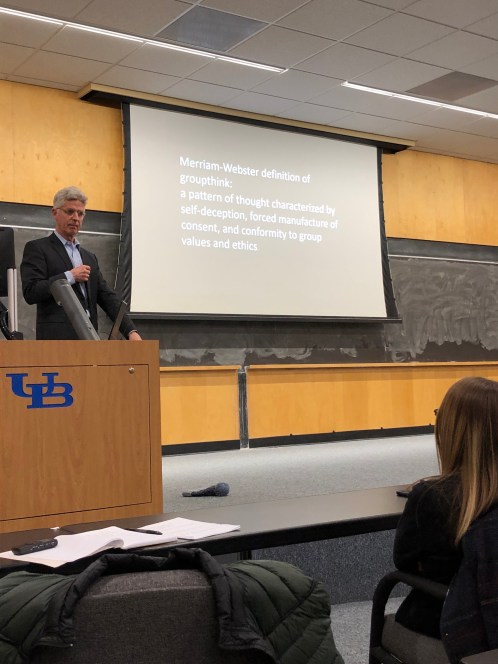
This is what Hartman sites as the main problem that comes along with a lack of diversity in the corporate world. He even goes as far as to link it directly with climate change, the influx in opiate addiction, the increase in the wealth gap, and the massive development of weaponry in America.
His solution to this way of thinking and corporate directing came from a Wall Street journal article out of the Buffalo News quoting a top female executive on Wall Street. She emphasizes just how important diversity in management is to the finance world. He quotes her in saying that almost every board of directors on Wall Street that incorporates gender, and ethnic diversity into their top levels of board members and directors, yields higher profits.
Hartman then goes into his own experiences working with public school teachers and college professors, all of whom have substantial retirement investment plans, Some accumulating millions of dollars each year. Many of the people he worked with, Hartman said, have no idea what they are investing their money in. this, Hartman states, is where the importance of Divestment comes into the picture.
Starting a retirement fund, or and investment portfolio, usually involves mutual funds. This is where the money that you invest is distributed throughout a number of different companies to yield the highest returns with little risk of losing your investment. But the down side is that most Americans have no idea where that money goes and which individual companies they are supporting.
Most of the highest rated mutual funds are obviously made up of some of the largest corporations in the world, many of which make their money by exploiting much of the working class and the environment with little to no sympathy for it. Companies like these (such as Exxon, noted by Hartman) are getting hundreds of million dollars in mutual fund investment from the American working class. These are what Hartman refers to as “Blood Stocks”
So how do we, as the American public properly divest in these “Blood Stocks” and create a sense of accountability for the Corporations we’re investing in?
Just like the rating system Morningstar which measures the performance of a stock on its risks and returns, Hartman brings up another system of rating that has recently been growing in popularity, ESG. ESG stands for environmental, social, and governance factors. The ESG rating uses a rating of one to five globes (Mirroring Morningstar’s one to five stars) to evaluate companies on their environmental and social consciousness to perspective investors. Investment companies such as Parnassus, adhere strongly to ESG accountability and transparency standards to ensure their investors that their money is being put to good use.
It’s more than just environmental and social awareness, Hartman said when describing himself as a “capitalist first”, and comically stating “This is a Hugo Boss suit!” while grabbing the collar of his jacket to prove it. He goes on the re-iterate how this practice of conscious divestment wouldn’t be so common, and how he, himself would not be such a strong advocate of it, unless it yielded significant returns. Hartman then goes on to add that if you look at ratings of most major stocks and funds that are evaluated by ESG, you see that many with high ESG ratings, have considerably high Morningstar ratings as well.
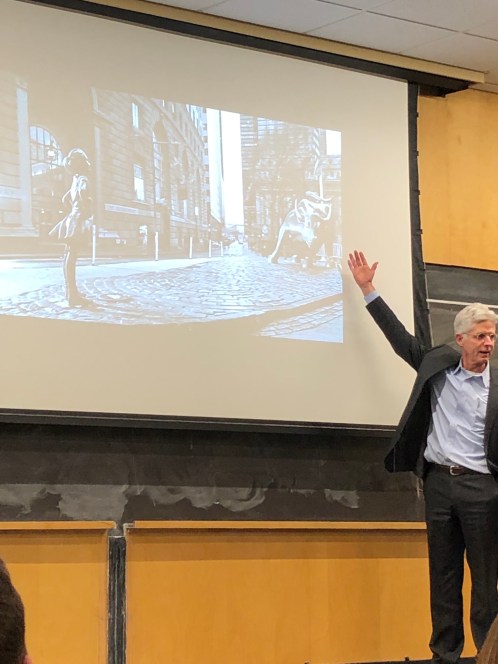
Hartman concludes by re-enforcing the idea that diversity in the corporate world not only leads to higher levels of social and environmental consciousness, but creates a platform for higher levels of innovation in growing fields like alternative and renewable energy.
All of this coming from a presentation at a public university, where much of the audience barely has enough money to put gas in your car let alone invest in mutual funds, what else can be done besides direct divestment? Responding to this question, Sydney Schaus, the president of UB’s Environmental Networking club stated the importance of getting involved in clubs such as EN as well as Fossil Free UB, a club that is actively collecting signatures to support the bill s1829 currently on the floor of the New York State Senate that requires all SUNY schools to actively divest from companies involved in fossil fuels.

 Diary of a Fourth Year Junior