Extracting fact from horror, and tragedy is a tedious practice. Being able to separate objective truth from the emotion and romanticism that shrouds many scenes covered by real life crime reporters is certainly a difficult task. “people say ‘you write about crime’ … I write about death and destruction. Which is kind of… like, morbid in a way” Veteran crime reporter, Aaron Besecker opened by saying.
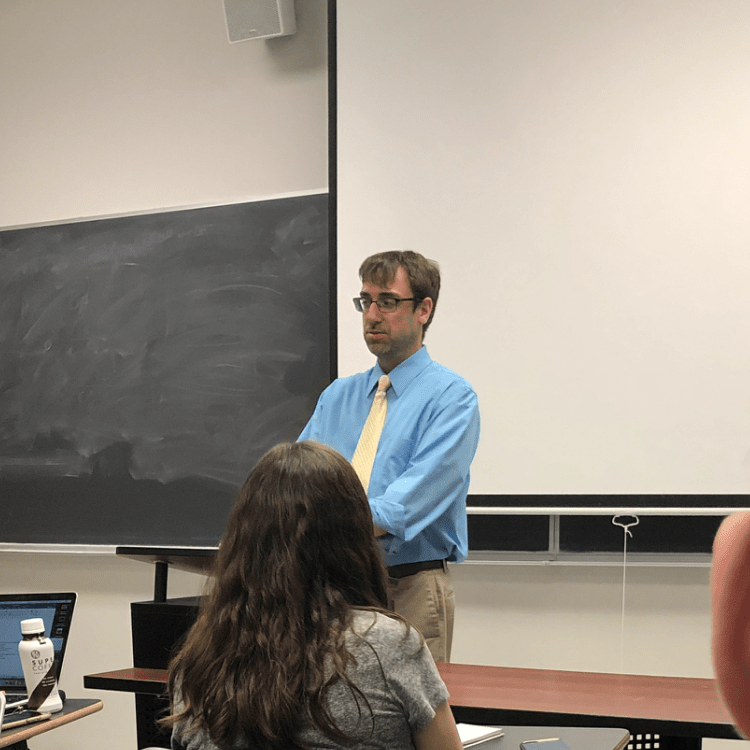
Besecker, a graduate of the University at Buffalo, has worked for the Buffalo News for the past 12 years holding a vast number of different positions, including City Hall coverage, 6 a.m. breaking news reporter, and assistant web editor. In his time of crime reporting Besecker has seen, and covered quite a bit in Western New York. He recounted his time covering both the City Grill shooting, a mass shooting in the City of Buffalo that left four dead and another four wounded; as well as the crash of flight 3407, a commercial airliner that went down in a residential suburb of Buffalo and leaving 50 people dead.
“You want to get the whole story about the person” Besecker stated when dealing with any tragic event. He went on tell of an an instance in which he had received severe backlash from not only the family but the police department alike for attempting to humanize the victim of a shooting that police believed was also involved in criminal activity. Besecker emphasized how much certain sources may have a skewed view on any specific person, and when dealing with death it is important to get the most objective information you can, saying “Some people assume .. youre just gunna write only nice things, and thats not my job. My job is to write the truth, my job is to write… reality”
Besecker was asked about his view of law enforcement, and how it had been shaped reporting on crime for the past decade. “I try to keep an open mind about it” he responded, noting that there are, simply, “bad apples”, however, “I have to be cognizant of the reality of this… police can be secretive, and they cover for each other”
Another difficult, yet crucial aspect of crime reporting Besecker touched on was having to talk with family and friends of victims shorty after a tragedy. however in the process of getting “the whole story about the person who died”, Besecker stated that, with regard to close friends and family, “usually the people who know the person the best are not in any shape to wanna talk to you”.
“I usually deal with alot of people who are… like having the worst week of their life” Besecker mentioned about his work. So how does a reporter approach people who are going through such a hard time in a way that will get them the best, and most reliable information, while staying respectful to their source? when asked Besecker said “alot of people understand, you know, your just trying to do your job.” and how even in some instances “people will use the interview process … as, like, their (source of) venting, … so if you happen to be on the other end of that … you can tell a story that way”.
Finally, Besecker addressed the recent technological transformation of journalism outlets. Touching on how writing and publishing online, opposed to hard print, affects the work of a journalist and the public response, especially for a crime reporter. He immediately made the observation of how much more criticism journalists receive in the age of the internet, given the relative ease of posting a comment online or writing an email. “If they had to write you a letter, you don’t hear any of this!” Besecker claimed. Addressing accusations of click bait, and how overuse of click bait articles can overshadow and dilute the work of honest journalists, Besecker stated that, although, “we want digital attention”, when accused of ‘want(ing) clicks’, as a journalist, “I do everything because I want people to read it”.

 Diary of a Fourth Year Junior