Paying for college has been a big issue in the United states for a long time. With college tuition and fees still on the rise the issue of financing an education is only becoming more pressing. In the past five years the State University of New York at Buffalo (UB) has increased its cost of attendance from roughly $8,000 in 2013, to over $10,000 in 2018. That margin is even greater for non-state residents, and international students; increasing from about $19,000 in 2013 to an astonishing $27,768 in 2018. Adding on-campus housing and a meal plan, as of 2019, some students are being charged over $44,000 each year. This is clearly a very unrealistic amount of money for an average family to pay in order to put a child through an undergraduate education. Finance plans do exist for many, including state and federal grants as well as loans. These programs are extremely helpful, and what many people rely on as the sole means of getting their education; however they are not all inclusive.
International students are charged non-resident tuition and fees; however, they are not eligible for state or federal aid. What options does this leave for those who can’t afford the outrageous $44,000 a year? Many rely partially on scholarship money to reduce the cost, and some even turn to private loan companies to help finance their education. Although, many still need to supplement that money with another means of income. Work.
International students compose nearly one third of the student body at UB, many of which need to find employment for a means of paying both tuition and living expenses. According to the Department of Homeland Security international students are restricted to on campus employment only for their first year of study, and even after that they are only permitted to work off campus through a program called Optional Practical Training (OPT). To obtain a position in a OPT program there is a string of hoops to jump through as well as many restrictions. A student must go through a designated school official in order to be recommended for an off campus position, and only then can they apply for a designated position that is in “their field of study”. On top of that OPT off-campus employment can only be held 20 hours a week, and is limited to a period of 12 months during their entire four years of college. Although some students do take this route, this is often not a viable means of employment to support the full cost of their education. This leaves many to turn to on-campus employment. In areas like the campus dinning services international students make up between 40 and 60 percent of the work force, by the account of a former employee.
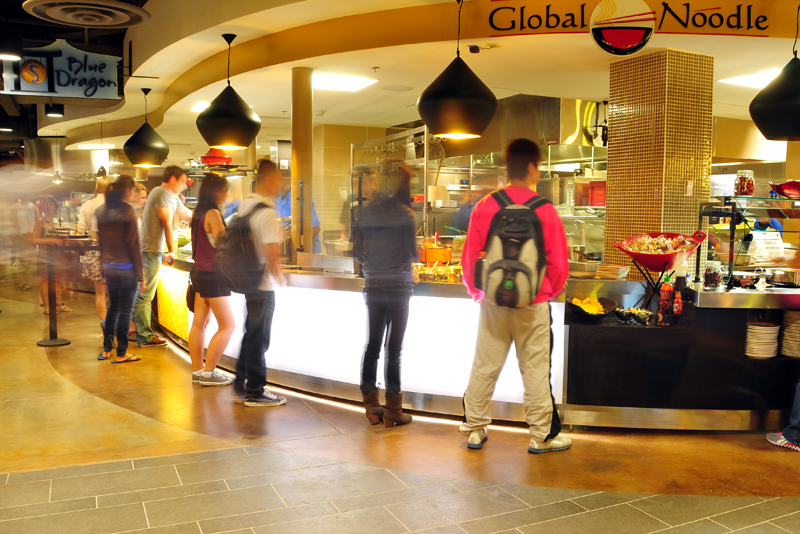
Finding a job on campus may not seem so bad with a New York State minimum wage set at $11.10/ hour; but remember back in 2013, tuition for international students was still a whopping $18,000 per year, not including room and board; and the state minimum wage was only $7.25/hour. A UB international student and former employee of the campus dining services talked about his experience. He stated that he was paid “Minimum wage, which then was $9.25 an hour”. When asked if the hours were flexible he responded “No, it was a five hour shift I had once a weekend. If no one picks it up I have to go, and if I don’t go I get fired” as well as “You’re supposed to, quote unquote, get fired (for missing your shift) but they give you like two or three warnings” when addressing the stringency of the policy. The former employee also mentioned how he was responsible for finding his own shift coverage even during finals week. “I quit before finals, there was no way I was going to work and no one was gunna pick up my shift too”
The issue with on-campus employment isn’t simply the low pay and lack of flexibility, it’s the absence of competition. The bargaining power for the employees is non-existent. As little leverage as a cashier at the food court may have, there still is the threat of leaving for the Wendy’s on the other side of the mall. It’s not much but it’s the incentive that drives employers to do better. For many international students there simply are no other options.
Unfortunately, there are no simple solutions to improve employment for many international students, and the University isn’t entirely at fault. They can’t change U.S. immigration policy to give students more employment opportunities. One option for the school, however, is to provide what is deemed as a ‘living wage’, or close to it. What constitutes as a living wage has been disputed across the country for years, and is different for every person. However, the school finds itself in a rare position acting as both employer and landlord. They have the means to determine exactly what the living costs are for each student; given in many cases they are the ones charging those expenses. Even with the New York State minimum wage being as high as it is in 2019, working 20 hours per week, many on-campus employees fall short of their room and board for the year by nearly $8,000.

Many international students who have no other option but to work on campus find themselves caught in this trap, with little to no say in their day to day employment; and although the school isn’t entirely to blame they are the ones who have the power to make that difference. And it is well overdue.

 Diary of a Fourth Year Junior