Diversity and Divestment, a Push to Raise Awareness for Sustainable Investment.

The small, well-equipped presentation room of Clemens 120 filled Monday night at 6 p.m. for a presentation and discussion put on by the University at Buffalo’s Environmental Networking club (EN) on the importance of Diversity and Divestment with their guest speaker JD Hartman, a former Wall Street banker

Hartman opened up with an anecdote about going from a semi-homeless political science grad to working in, arguably, the biggest investment collaboration in the world. He said It relied on one thing. Privilege.

“I just had access, you know what I mean?” Hartman recounted when telling about his efforts time and time again walking in to baking companies cold and asking to schedule an interview. He emphasized that as a white man in New York City In the early 1980’s privilege is “what gets you through the front door”.

Eventually getting his in, and moving up the chain Hartman became the assistant vice president at JP Morgan Chase, and then the senior managing director at Lebenthal & Co. Inc.

Hartman notes the irony he felt at Lebethol & Co., being on a board full of white men at a finical company founded by a woman. He then used the term ‘groupthink’, defined by Merriam-Webster as “A Pattern of Thought Characterized by self-deception, forced manufacture of consent, and conformity to group values and ethics.”, to describe the issues you run into when working on collaborative projects with an ethnically, or socioeconomically homogeneous group.
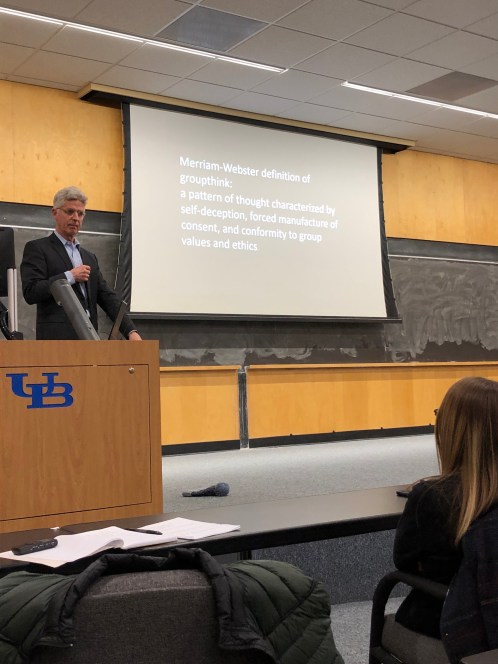
image1
Hartman on the theory of ‘groupthink’

This is what Hartman sites as the main problem that comes along with a lack of diversity in the corporate world. He even goes as far as to link it directly with climate change, the influx in opiate addiction, the increase in the wealth gap, and the massive development of weaponry in America.


His solution to this way of thinking and corporate directing came from a Wall Street journal article out of the Buffalo News quoting a top female executive on Wall Street. She emphasizes just how important diversity in management is to the finance world. He quotes her in saying that almost every board of directors on Wall Street that incorporates gender, and ethnic diversity into their top levels of board members and directors, yields higher profits.


Hartman then goes into his own experiences working with public school teachers and college professors, all of whom have substantial retirement investment plans, Some accumulating millions of dollars each year. Many of the people he worked with, Hartman said,  have no idea what they are investing their money in. this, Hartman states, is where the importance of Divestment comes into the picture.

Starting a retirement fund, or and investment portfolio, usually involves mutual funds. This is where the money that you invest is distributed throughout a number of different companies to yield the highest returns with little risk of losing your investment. But the down side is that most Americans have no idea where that money goes and which individual companies they are supporting.

Most of the highest rated mutual funds are obviously made up of some of the largest corporations in the world, many of which make their money by exploiting much of the working class and the environment with little to no sympathy for it. Companies like these (such as Exxon, noted by Hartman) are getting hundreds of million dollars in mutual fund investment from the American working class. These are what Hartman refers to as “Blood Stocks”

So how do we, as the American public properly divest in these “Blood Stocks” and create a sense of accountability for the Corporations we’re investing in?

Just like the rating system Morningstar which measures the performance of a stock on its risks and returns, Hartman brings up another system of rating that has recently been growing in popularity, ESG. ESG stands for environmental, social, and governance factors. The ESG rating uses a rating of one to five globes (Mirroring Morningstar’s one to five stars) to evaluate companies on their environmental and social consciousness to perspective investors. Investment companies such as Parnassus, adhere strongly to ESG accountability and transparency standards to ensure their investors that their money is being put to good use.

It’s more than just environmental and social awareness, Hartman said when describing himself as a “capitalist first”, and comically stating “This is a Hugo Boss suit!” while grabbing the collar of his jacket to prove it. He goes on the re-iterate how this practice of conscious divestment wouldn’t be so common, and how he, himself would not be such a strong advocate of it, unless it yielded significant returns. Hartman then goes on to add that if you look at ratings of most major stocks and funds that are evaluated by ESG, you see that many with high ESG ratings, have considerably high Morningstar ratings as well.
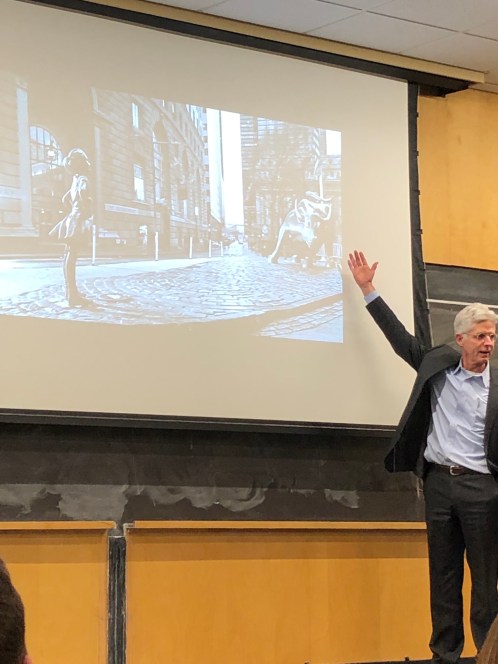
image3
Hartman referencing the iconic statue of the small girl standing up to the bull on Wall Street


Hartman concludes by re-enforcing the idea that diversity in the corporate world not only leads to higher levels of social and environmental consciousness, but creates a platform for higher levels of innovation in growing fields like alternative and renewable energy.


All of this coming from a presentation at a public university, where much of the audience barely has enough money to put gas in your car let alone invest in mutual funds, what else can be done besides direct divestment? Responding to this question, Sydney Schaus, the president of UB’s Environmental Networking club stated the importance of getting involved in clubs such as EN as well as Fossil Free UB, a club that is actively collecting signatures to support the bill s1829 currently on the floor of the New York State Senate that requires all SUNY schools to actively divest from companies involved in fossil fuels.
Born from Ice or Powder?

gore
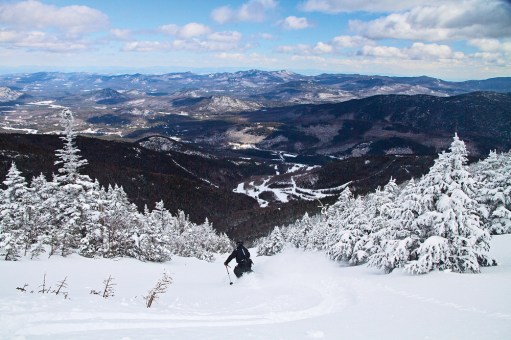
Gore MT.- Adirondack State park, NY

Keeping with, what appears to be the theme of this week, I want to post a bit about a small point of contention in the world of skiing, and snowboarding. That would be the ongoing underground competition between East coast and Central/West coast skiers and boarders. With the Obvious allure of warmer weather, and deeper powder in places like the famous Tullaride,Collorado, and lake Tahoe region of northern California many do indeed argue that the mountains west of the Mississippi river are where the “real skiing” happens. In opposition, the cold weather, Ice hardened skiers of Vermont, New Hampshire, and Upstate New York tend to believe that if you grow up hurtling down a sheet of ice in sub-zero temperatures, you can brave it anywhere in the world.

I figured I would take this opportunity and weigh the pros and cons of both. Growing up in upstate New York, and learning on mountains in the frozen ice palace that is the Adirondack state park, I can personally attest to the fact that barreling down sheets of ice at a 45-degree angle with little-to-no control puts just as much ice in your veins as it does below your skis. That’s not to say it gives you the edge up on those out west, who deal with more tree-invested glades and avalanches than you’ll ever see on the Atlantic. Not to mention some of the most famous American boarders and skiers come from the West coast Including the flying tomato himself, Mr. Shaun White.


It is true that the big mountain resorts in Utah, California, and Colorado (Telluride reaching 400,000 guests annually) certainly draw more from the vacation crowd in the US, however Recent state ownership of three of the biggest mountains in New York state, Gore mt. (Adirondacks), Bellaire mt. (Catskills), and White Face mt. (Adirondacks), has caused rates to drop and attendance to skyrocket, especially for local Northeasterners, as a whole new population of east coast skiers join the cause.

With a massive increase in ski schools and academies across both east coast and west coast territory, more younglings than ever are taking to the slopes. And as organizations and brands such as ‘Far West Ski Association- The voice of the Western Skier’ and ‘Ski the East- Born from Ice’ keep growing, the competition will keep on for seasons to come in what the Beach boys called the “Endless Summer [ Snowday] “.

endless summer


The Best Thing I read This Week

After reading the Pulitzer winning ‘Snowfall’ last week, I was surfing some travel news, perhaps subconsciously hoping I could be out on the ski slopes rather than reading a political science textbook, and an article on avalanche safety caught my eye. Sighting all of the injuries and fatalities in both backcountry and in-bound avalanches throughout the past decade, they mentioned an Incident that occurred at the Taos ski resort in New Mexico just last month. This brought me to a separate piece on the history and development of Taos, where two young skiers were killed in an In-bound avalanche this January.

Taos Had History and Mystique, but Few Skiers. Can a New Owner Change That?

Reluctantly clicking on this article, half expecting an ad campaign for another high-class resort, this piece went into how long and personal the history of this mountain really is, and how, under new ownership, it really is on its way to revolutionizing the world of big-mountain skiing, while still keeping its roots.

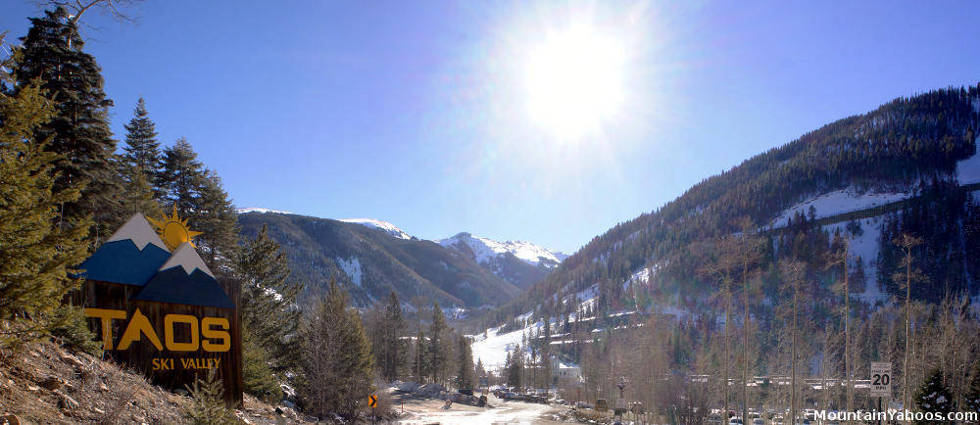
Taos ski valley

The article opens with a quote from one of the long time regulars of the mountain and ski patrol member, Dave Hahn. After being asked what he thought when he heard the owner was selling the place, Hahn responded, Light heartedly “That’s funny, a lot of us thought we owned it.” Within the first paragraph of the article you understand how deep of a connection many people had with the mountain, and how important it was to the writer to get that point across. Shortly after the writer mentions the history of the mountain and the allure of the desert-like scenery surrounding it. After knowing the property was sold, hearing a ‘Mom and Pop’ history behind the mountain, mixed with a beautiful description of the surrounding nature will give any ski loving reading a familiar anxiety about what its new, corporate buyer may have in store.

After being sold to international real-estate mogul, Louis Bacon, the resort took on 300 million dollars’ worth of renovations. From a new monstrous base hotel, to a controversial ski lift taking skiers up to the dangerous terrain where the fatal avalanche occurred. Mentioned later in the article was a long time trust between Bacon and former owner Mickey Blake. The Blake family new that Bacon was interested, and in their words saying “He’s headed in the direction we wanted to go.” This does ease some of the initial resentment toward the new corporate ownership. What immediately got me on the website ready to book my trip to Taos, however, was hearing that once under the new ownership Taos was active seeking an B-corp badge.

To become a certified B-corporation you must, in their words “meet the highest standard of verified social and environmental performance, transparency, and accountability”. For a business that size to earn this certification, it means millions of dollars a year must be spent in reducing the environmental impact or your business, providing strong benefits and high wages to employees, and making charitable donations in the community.

To see a place like Taos be bought out and turned into a large cooperation-style mountain is never initially heartwarming, but knowing it’s in good hands and growing as a conscious sustainable business that gives back to the community and the environment can really restore one’s faith in a growing corporate world.

My Favorite Place on Campus

Possibly working through some bias as a lifetime ‘aquatics enthusiast’, my favorite place on campus would have to be the University pool in Alumni Arena. There are quite a bit of sub-par luxury and recreation spots on campus such as the tearing and uneven turf of Kunz field, the ‘no-tipped’ Q’s, and ripped felt pool tables of the Ellicott rec rooms, and of course… Moe’s. Unexpectedly the entire aquatics center may just make up for the rest of UB falling a bit short.

ub pool

Although the pool was once home to a prestigious men’s NCAA division I swimming team, and is still home to a quite exceptional women’s team, as just a mere student(non)-athlete I am happy to reap the benefits of their hard work. With nearly half of the Athletes it was built for gone in the Infamous ‘UB sports cut of 2017’ much of the pool space goes to us mere mortals on the armature club swimming and water polo teams.

That really is just it. What makes the 25×50 yard pool and 18-foot-deep diving well so extraordinary, is that, at the time of its construction, it was truly tailored to competitive swimmers and divers. You don’t have to worry about kids splashing around in the shallow end, or old ladies in water aerobics complaining that the water is too cold. (It’s supposed to be cold, ok!? When you’re in the water you can’t sweat, so if you’re actually doing a workout you’ll over heat unless the water is cold enough to cool you down.)

I do think it is very rare to find facilities such as the pool on campus, that are as professional in their facility quality as well as they are in their staffing, and are open to the general student body. As much as I may, or may not feel for all those athletes who lost their team on the fateful morning in the spring of 2017, thanks for the extra space.

The Best Thing I Read This Week


As intrigued as I am with the political implications of Spanish exploration, beautifully outlined by my Colonial History text book, the best thing I read this week was The New York Times  “Surfing Remade in the Rockaways”

surf nyc

Outlined in any form of media from analytically written history books on the origins of surfing, to episodes of Drunk History starring Jason Mantzoukas, It’s clear that the sport is a lifestyle to those serious about it. This article discusses the issue of a cultural, and mainly racial divide in the sport.

Taking place mainly on the East coast (The Rockaway beach of Long Island) the surfing culture is a bit Isolated from the large surfing world of California and Hawaii. The author does a fantastic job of expressing how unique the culture of New York City (area) surfing really is, expressing how most people in the area either start or their surfing career as skateboarders, or supplement ocean riding with its sister sport on the pavement. Another element of surfing culture unique to the urban area where cultural segregation has a strong presence, is using the sport as an extracurricular activity for much of the youth population in the area.

This Idea is a driving force in the article, and a reason why one of the main subjects in the article, Louis Harris, opened the east coast chapter of the Black Surfing association in NYC. Stressing the importance of this element the author sites another article of a deadly fire set by a high school student simply due to boredom, and states how detrimental that was to Harris.

Highlighting the informal segregation on the beach which is cemented by economic inequality in the area, the author notes how absurdly expensive it is to park on Rockaway with a non-resident permit, and how when originally constructed; the beach, suspiciously, did not have any access by public transportation. Many like Harris are building the Idea of inner city surfing by transitioning lifetime skaters to take their skills to the surf, as well as gaining lots of attention and media by institutions like the Black Surfing Association, and obviously the eye of the New York Times.